
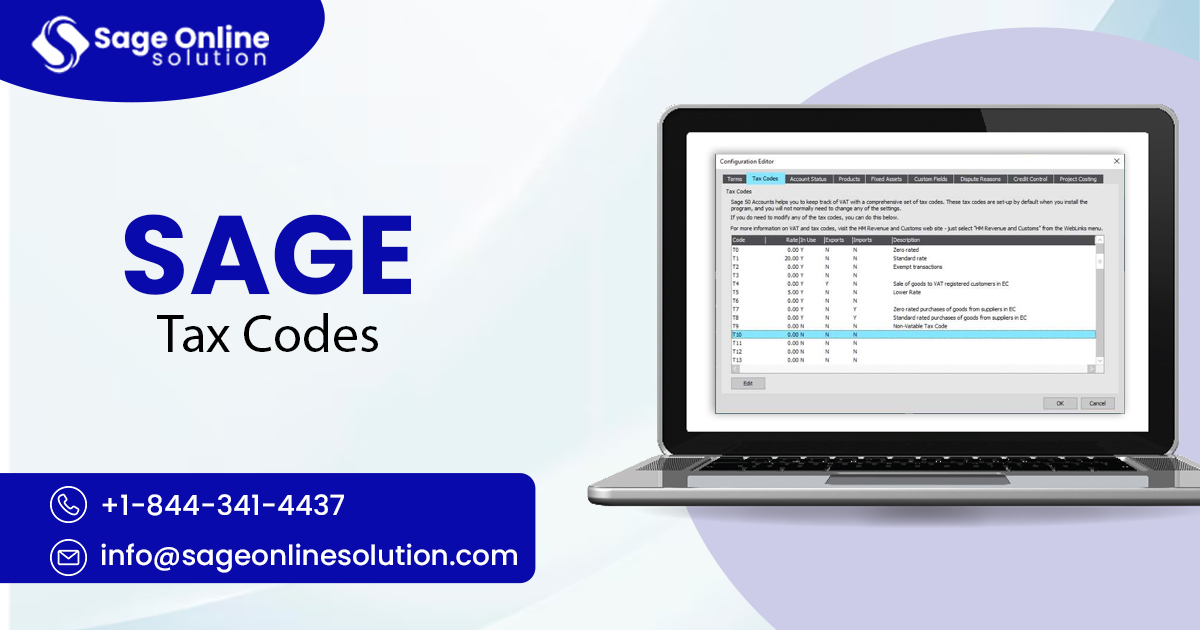
Sage 50 Tax Codes play a central role in how your accounting data flows through the system, how VAT or sales tax is calculated, and how accurate your reports look at year-end. To keep your books compliant and error-free, you need to understand the Sage 50 tax codes list, how codes like t0, t2, and t9 behave, and how to update them when legislation or business rules change. If you are facing frequent tax calculation errors or confusion with specific codes, you can always reach expert, real-time assistance at +1-844-341-4437 for guided troubleshooting.
Understanding Sage 50 Tax Codes
Sage 50 Tax Codes are labels that tell the software how to treat tax on each line of your sales and purchase transactions. When you assign the correct Sage tax code to a product, service, customer, or supplier, Sage automatically calculates the tax amount, separates net and tax values, and posts everything to the right ledger accounts. In practice, tax codes Sage users set today affect every invoice, credit note, and journal they create tomorrow.
Within Sage 50, tax codes can represent standard-rated tax, zero-rated tax, exempt transactions, or out-of-scope items. A well-structured Sage 50 tax codes list is not just an administrative detail; it is the engine behind accurate VAT or sales tax returns, audit-ready reports, and smooth reconciliation. When codes are misconfigured, you often see discrepancies in return figures, misposted tax balances, or errors when running tax reports.
Why Updating Tax Codes Matters
Tax rules and rates change over time, and Sage 50 must reflect those changes accurately. If you continue using outdated Sage 50 tax codes after a rate or rule change, your invoices and tax reports will be wrong, leading to underpayment or overpayment of tax. That is why a regular review and update of tax codes Sage uses is a best practice every accounting team should follow.
Updating Sage 50 Tax Codes also matters when your business changes. For example, expanding into new regions, adding new product categories, or starting cross-border trading may require new codes or adjustments to existing ones. The more complex your operation becomes, the more crucial a clean, well-documented Sage 50 tax codes list is for clarity and compliance.
Overview of Common Sage 50 Tax Codes
Every business can customize codes, but many Sage 50 setups follow a familiar pattern of core tax codes. Understanding how these typical codes behave helps when you review, update, or troubleshoot your configuration.
Common concepts you will see in most Sage 50 tax codes setups:
Standard-rated codes for goods and services that attract the full rate of tax.
Zero-rated codes for items that are taxable in principle, but currently taxed at 0%.
Exempt codes for transactions that do not carry tax under your jurisdiction’s rules.
Out-of-scope codes for items completely outside VAT/sales tax reporting.
While the exact labels vary, codes like t0, t2, and t9 often represent specific treatments that accountants refer to daily when entering or reviewing transactions.
t0 Tax Code in Sage 50
The t0 tax code Sage users see typically represents a zero-rated tax treatment. Zero-rated means the item is taxable, but the current tax rate is zero, so Sage records the transaction for reporting purposes without charging tax. This is common for certain types of goods and services depending on local tax rules, such as qualifying exports or specific zero-rated products.
From a workflow perspective, using the t0 tax code correctly ensures that those transactions still appear in the right boxes on your tax return, even though the tax amount is zero. If t0 is misconfigured or misused, you may find that zero-rated sales appear incorrectly as exempt or standard-rated, distorting your report and possibly triggering questions from tax authorities.
t2 Tax Code in Sage 50
The t2 tax code Sage users rely on frequently is often set up as an exempt or special treatment tax code. Exempt means that no tax is charged, and those transactions usually fall into separate reporting categories from zero-rated transactions. In some setups, t2 might also be used for specific reduced-rate or non-standard scenarios, depending on how your accountant or implementation team configured Sage 50.
Correctly applying the t2 tax code in Sage ensures that exempt transactions do not get mixed in with standard-rated ones and that your tax reports show the right totals for exempt supplies. Misusing t2 on invoices that should be standard or zero-rated can cause under-declared tax, while incorrectly marking items exempt can create mismatches between your accounting system and tax return.
t9 Tax Code in Sage 50
The t9 tax code Sage often uses is typically reserved for out-of-scope transactions. Out-of-scope items are not part of the VAT or sales tax system at all, meaning they should not appear in your tax return boxes. Examples might include certain internal journals, wages, or other non-taxable movements that must be recorded in your accounts but are not part of the tax calculation.
Using the t9 tax code correctly keeps your tax returns clean and focused only on relevant taxable and reportable transactions. If you mistakenly use t9 on sales that should be standard-rated, your reports will omit those amounts entirely from tax calculations, leading to serious under-reporting issues. That is why a clear internal policy around when to use t9 tax code Sage provides is essential.
Building a Clean Sage 50 Tax Codes List
A well-organized Sage 50 tax codes list should be:
Clearly named and documented so staff know exactly when to use each code.
Mapped correctly to tax rates, ledgers, and tax authorities.
Reviewed regularly, especially after software updates or tax legislation changes.
For example, your list might group standard-rate codes together (such as t1 or equivalent), zero-rated codes like t0, exempt codes like t2, out-of-scope codes like t9, and any custom codes used for special sectors or regions. The goal is to make it easy for users to select the right code at the point of entry, minimizing errors later in the reporting cycle.
How to Update Sage 50 Tax Codes
When it is time to update Sage 50 Tax Codes, you should follow a structured process rather than editing at random. A typical approach includes:
Review existing codes and identify which ones need rate or description changes.
Check current tax legislation or guidance to confirm the new rate or treatment.
Decide whether to edit the existing code or create a new one to preserve historical integrity.
Update the rate, description, and linked ledger accounts accordingly.
Test with sample transactions to confirm that calculations and postings are correct.
Many businesses prefer to create new codes instead of editing old ones, especially when rates change. This keeps old transactions using the old code and rate intact, which helps during audits and historical comparisons. However, in simpler environments, updating an existing code might be acceptable, provided you understand the impact on reporting and future entries.
Avoiding Common Tax Code Errors
Errors with Sage 50 tax codes usually fall into a few recurring patterns that you can watch for:
Assigning the wrong code on sales or purchase transactions, such as using t9 when standard tax applies.
Forgetting to update codes when tax rates change, causing ongoing miscalculations.
Inconsistent use of codes across departments, leading to messy reports.
Lack of documentation, which leaves new staff guessing which code is correct.
To prevent these issues, it is wise to standardize your tax code usage across the company, train users on the meaning of each code (especially t0, t2, and t9), and run periodic checks on posted transactions. Spot-checking invoices and comparing tax totals against expectations can help you catch miscodes early, before they roll up into quarterly or annual returns.
Best Practices for Managing Sage Tax Codes
To keep your Sage 50 Tax Codes accurate and effective over time, consider integrating these best practices into your accounting routine:
Maintain a written guide that explains each sage tax code, when to use it, and what it represents.
Lock down who can create or edit codes to avoid accidental configuration changes.
Align your sage 50 tax codes list with advice from your accountant or tax consultant.
Schedule regular reviews, especially around fiscal year-end or after software tax updates.
These habits reduce confusion, keep your tax accounting aligned with regulations, and make your Sage system easier to manage as the business grows. When a tax inspector or external auditor reviews your records, a clean and consistent tax coding structure will reflect well on your internal controls.
Fixing Tax Code-Related Errors Fast
When tax codes are wrong, the impact shows up quickly in transaction totals and tax reports. Fixing errors involves both correcting your configuration and repairing affected transactions. In many cases, you will need to:
Adjust wrongly coded invoices or bills by issuing credit notes and re-invoicing with the correct code.
Re-run tax reports after corrections to ensure figures align with your new coding.
Check that control accounts and tax liability balances still agree after adjustments.
Because tax code errors can span many transactions, working through them manually may be time-consuming. That is one reason some businesses choose to get professional help when they notice repeated mistakes, especially involving critical codes such as t0 tax code Sage uses for zero-rated items, t2 tax code Sage uses for exempt transactions, or t9 tax code Sage uses for out-of-scope postings.
Keeping Sage 50 Ready for Tax Changes
Tax environments evolve, and so should your Sage 50 configuration. To stay ahead:
Monitor announcements from tax authorities about rate or rule changes.
Apply Sage 50 tax updates and patches promptly to keep the system aligned with new legislation.
Review your sage 50 tax codes list after each update to confirm that all key codes still behave as expected.
Proactively maintaining Sage 50 Tax Codes helps you avoid scrambling at the last moment before a filing deadline. With a predictable review cycle, you can test new codes, train staff on changes, and ensure that postings remain accurate across the board.
When to Get Expert Help
Not every tax scenario is straightforward. Multiple jurisdictions, special schemes, or frequent rate changes can make it difficult to keep Sage 50 Tax Codes perfectly aligned with reality. If your team is spending more time correcting mistakes than doing productive work, it may be time to call in a specialist.
Experienced Sage consultants can review your setup, identify weak spots in your tax code design, and help redesign your sage 50 tax codes list for long-term clarity and compliance. They can also guide you on properly handling legacy codes, mapping them to current rules, and cleaning up historical data where necessary. For quick, personalized help with configuration, review, or error fixing around your Sage 50 Tax Codes, you can reach a dedicated support expert at +1-844-341-4437 for practical, step-by-step assistance.